I'm twenty-one years old
and you seem older than the hills
yet you're new here
and I feel ancient.
We're hard to get to know,
I agree, but I'm easy to forget,
it seems. I'm waiting
to write poems like you, Gil,
I'm waiting with the mist
on my mind, floating
up through my nostils
on the midnight wind
in the magic hour. I breathe
deep and clean until
my vision is shaky
and I can hardly stand.
Then it comes to me:
a thought floating out
of the night (which,
in the city, never darkens)
and I catch it
- my perception is acute,
even if my will faulters.
I draw the enigma
out of the orange sky
of smokestacks and gazometres,
overpasses and bus shelters.
I pick it from the corners
of billboards and from
under litter bins, between
a sleeping vagrant's teeth,
pull it through the blades
of a local green
and into the road
with the pigeons
and drunken stories
gathered up from
newspaper clippings.
- Her with her tits out,
with all the opinions
on me and you, everything,
better she tells it;
I wouldn't be taken
seriously, no second glance,
they may as well have
seen straight through me,
I do, anyway.
That thought I had,
pure as the gum
on my shoe: I picked
that up somewhere too.
I've gone pretty far
now; I have to make
it look intentional.
I did it on purpose,
I heard a poem
on a street corner
and made a turn,
blind as a farmboy
in the age of bluesman
who played slide guitar
and women like cards.
I'm here thinking this
in an old place -
it's a good thought
and I'm new to it.
I'm having fun
so I'll make
the rules up after
I've summed up
the scores, let's
see: one to me,
a handfull of revolutions,
a record deal and
fisherman's hat for you.
Let's start over;
I've got troubles
like everyone else,
no eagles on me,
no broken homes allowed,
we'll keep our voices
of reason, we can
always turn around.
2010-11-18
For Gil Scott-Heron (I'm New Here Too)

2010-09-16
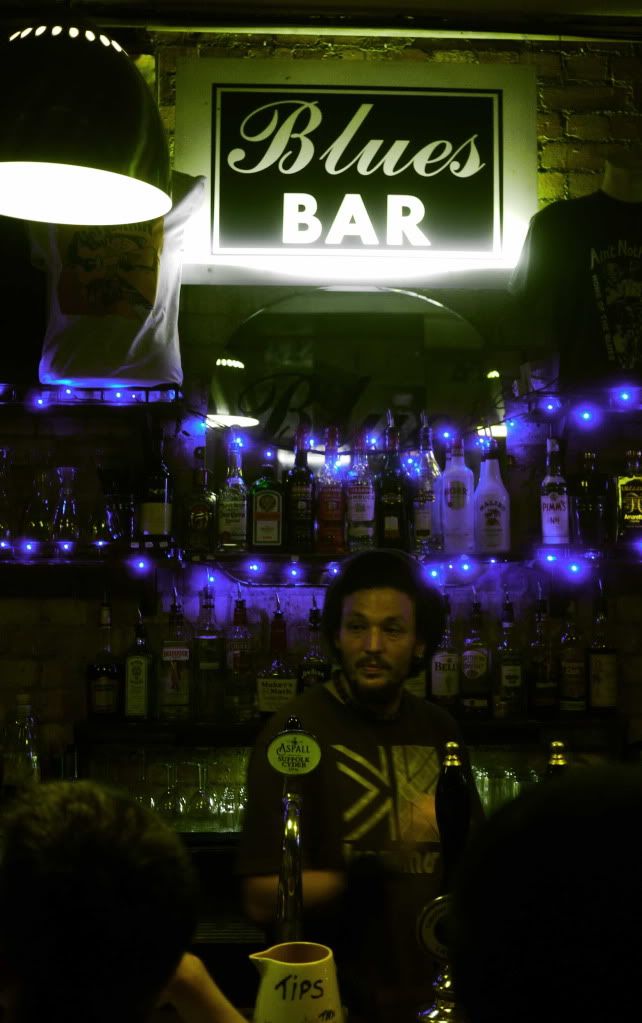
Shooting from the Hip #2 (Blues Bar)
 Man, I had the best time at 20
I asked, "You've changed since then?"
No; if I had, I'd've gone mental,
been thrown in hospital,
therapy and all that, I tell you
one thing: I fucking hate Woody Allen.
2010-07-27
Jazz, Bleedin' Kohl and a Howlin' Trumpet Blast

I thought it best not to pursue
the nature and causes of my illusions
when I discovered her in the mirror
behind the spirits in a stray cat jazz bar
- one where raucous chapters,
as if written by a feverish
film director, are captured
in the midnight hours by a single
wink of Kegman Kovacs,
crooked on his stool behind
his bandit register – her wide-eyed
glare was the perfect bromide
for this saloon thick with
the accents of moral dissolution:
she’d glimpsed some idyllic
future scene and the thought
remained flushed on her cheeks.
As the creator of this ideal
enlivened with eloquent details,
excerpts from classic fiction
(encouraging second guesses
from Pulitzer marksmen,
compelling in their list-making),
this glossy idol of bourgeois
abstraction feigning realism,
I choose a road that is straight
and narrow, I don’t even need
to determine the direction
I travel – I’m not going back;
She consistently suggests movement,
accompanied by a leitmotif:
the howling blast of a trumpet,
a complex enigma coded
by a triad of valves and the bitter
freedom of a private life
released from public silence.
All this time I accept
she is not next to me
but on stage, amber candent
bulbs warming her face.
The band is her gang:
a vicious platoon enlisted
as a tragic ballast drilled by a single
ambitious woman. An artist,
my essence in my creative capacity,
I hold no monopoly on integrity,
forgetting the monologue,
remembering only the speaker
from the imbecile chaos
of the boot-heel chipped oak floor.
We for the minute are her closest
friends like a chance collection
of driftwood, our scepticism
relinquished from our malt,
for our craving to believe
is desperate and deep.
We beg for reward
like the queue for a soup kitchen
and with just as much dignity.
She offers a flash of information
ripe with sexual suggestion,
the grand spectrum
from love to anger painted
with a vast collection
of colours. This sylph
singing for us, a siren on a cliff
ready to wreck our passing ship,
bewildered by the obscure guilt
of a burgeoning, heated affair,
defending herself
from token wisdom
with a sinister wit emanating
from behind the flash of her teeth
across a twelve-bar riff,
displaying the dagger
but masking its poisoned
flavour with the hilt
In a slow section she leaves a kiss
on the gauze of her microphone,
a blood red smear of lipstick
- she came to sing for them
but she dances for me, hanging
on behind her with my guitar
slung like a weapon.
Before we began she only gave
me a key and a couple clicks
for the rhythm.
My turn, I sharpen my razor wires
on each flinching hat,
a trembling ride, a nickel
wound shake to every kick
from the ground. There’s
alleyway justice in my screams:
a cut to the face if you stray
from your station, every time
I break rank I fear ambush at Cerriglio.
I dissect your mood for the crowd
and find a tune for the words
she couldn’t place but now
lie naked on my operating table.
Bleeding kohl down her cheeks
She smiles at me, having forgotten
the people listening unaware
of the true purpose of our plot.
2010-06-08
Sharp Noir (Part V)
Rubix reported a lingering dread
- an idiosyncrasy of this particular
model, although a noble sentiment –
filed undisclosed natural causes;
we all know what that means.
They’ll gibbet Cassis as an example
for striking pins at this level:
life isn’t all beer and skittles
when dealing decks a fatality situation.
a light whisper of a night-train
flutters just above the roof,
taps enough to imply the wind
and talk of the sea it’s from.
Picking at the nightmares between
reality and dream, Cassis, half-
sitting, may become a regular
footnote stranger, dissolving tears
in alcohol to avoid making a scene.
Havoc has been wrought
on his midbrain by alternating
sedatives and stimulants.
Rolling up the tag like
a little newspaper, reining in
a bucket from a mossed well,
Noir retrieves a teabag
from Cassis' mug.
We imagine the procession:
two files like heavy curtains
breezing each other
as the mourners wobble
in their short, slow steps;
Rubix smoking because,
like most actors, she knows
not what to do with her hands.
In our darkest reflections, of love and death,
our thoughts are potent with the Colonel.
Sharp Noir (Part II)
In the atrophic night-time,
a bluesman hides between
hotel rooms under an assumed name;
a friend once removed
of Harriet Tubman, “You’ll
be free or die.” He mists
a pane to meet the gaze
of a supermodel’s hound
on the street below:
two orgiastic flashbulbs
over a set of opal barbs.
The illustrious are ushered in
as the midnight wind
turns cooked to raw;
an excessive saccharine
of single line anathemas
punctuate the eluting, grain liquor
payola correspondence of
the cerberi at the door, who
with each glance convict
me of loitering.
I elbow-pin the Herald
as a prop only, roll and spark
to employ the hands,
looking down, counting old gum.
They Zippo lick me with scimitar
eyes well drilled from working
the derby Switchboard.
To a scherzo laced with code,
we infect each other with smiles,
impersonal benevolence: an old-style
injunction now just a passing
trick glimpsing teeth.
I’m standing ad hoc,
antonym to this vulgar mode
and so attract the intentions
of the heaped obscenities
- one enormous flexing nerve
counting Houblons; their effluvium
smacks of it, spectres quickly
make them for tea, pectin,
dunking pound cake.
They got cured fitting last
winter’s coats and turning
out the pockets.
One gorged Boa says,
“Boy – you Kasey Jones?”
A fork to his wit, I return,
“The name’s Romano, relax
- I’m only here for the Jazz.”
“Drag about your Dad,
we’ve got what’cha need.”
The waitress thinks
I’m Omar Sharif minus mustache.
Singularly original, a sufferer
from the delirium of higher intelligence,
The Noir Balladeer calmly sits,
plays Rhapsody in Blue
on a comb and tissue paper;
an outpatient from the
mild deviant ward: sectioned
for incendiary poetry,
she wrote songs on her padded walls,
bade the multitudes get a grip,
amongst the tempestuous noises
of sadism in this sparking jive nexus.
Grab a ticket at the desk.
Dr. Cassis, a hollow-eyed
technician from the plague era,
operates here, a conscript pedlar
of syrup and pills to vexed
kinship systems long overdue
extinction: a shamski lawyer
of medicine, errand runner
at the Chaumière de Dolmance.
There’s a sharpening of vision
in his waiting room:
we’re drowners thirsty to our
last breaths, even the reptile
gamblers adopt the stoicism
of wage earners. We discard
our beliefs at the ballot desk
like heavy, plumed helmets
too hot to wear in the midday sun.
Cassis murdered his guides
to be on the safe side,
carved runes of aptitude
in every cubicle until recruited
to the court of the Rubix Queen.
Her Switchboard mechanism
is perpetual, manned out of habit,
implies its necessity
and so creates pundits and enthusiasts,
equally fecundates the angst
of bitter jetsam to its ascribed kismet.
As one of the Rubix Queen’s courtiers,
lost in spontaneous furies,
surroundings seem incidental;
I stretch wide my arms
as if to perform some kind of dance
- perhaps among the antebellum pillars
of disgrace this desperation will fade.
Now, for the first time,
this protagonist can be spared
tedium and relish scandal in her
high-society supporting cast
of refugee artmen, never redden
again in shame when mentioning
the considered prurient in front
of those too desensitized
by talcum to welcome pleasures
stoked close to core desires,
forget axioms and tenets drummed
into her when she was young and Christian.
Some new lover will glide
into bed like a moonbeam
and I will accede entirely,
consumed by the immediate,
no thought to consequence
- tragedy rewards so the immortal
may die, a comedy is torn:
no audience laughs at the same joke
twice – my mind skips as of
a man bred in the wild,
every obstacle met in silence;
only with the caballi
will I produce ravings
of the most obscure kink.
In the thrill of lovers’ gambit
my watch trips backwards
and a casket of weakness
is exposed, drawing with it
an unctuous sickness,
irresolvable in my discomfort,
as when I thought it ruminative
for great heroes to die young;
one of mine said everybody does.
Some lives cuff out as
mis-quotations of popular phrase,
The Colonel’s was one to glimpse
the truer scansion of the iambic universe,
his history spelt out in short, dim
telegrams like the subject of myth.
always fearing to awaken and find
himself dead, he advised, “Kiss the girl
next to you, take upward flight,
forget the cold outside.”
To each charge I show
a new side to my prism,
a simple note in the margin
of a newspaper column.
maybe, like him, one night
idle love will conspire a razor’s
whisper around my throat.